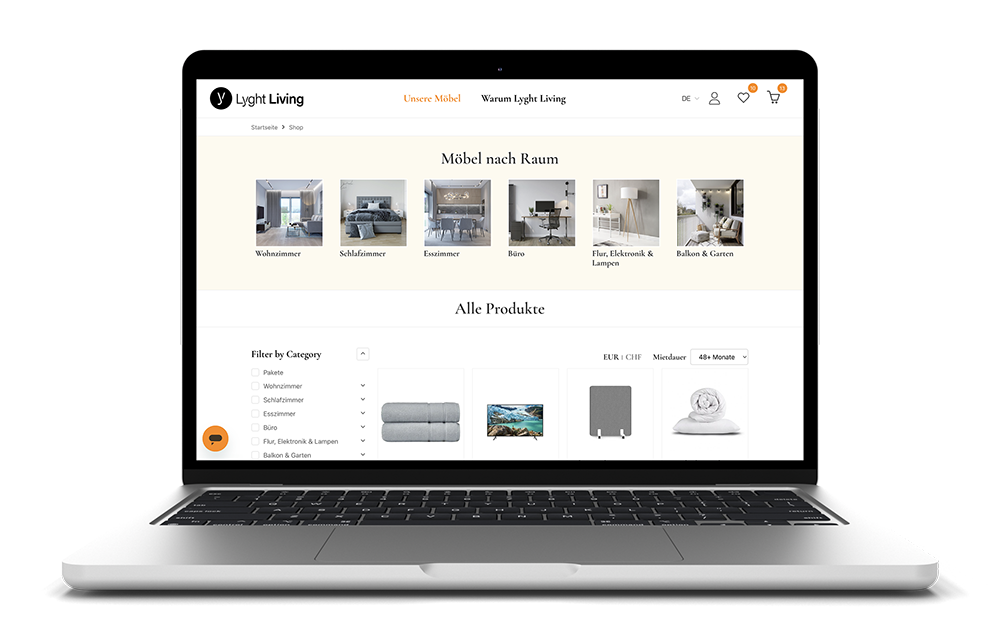
A relocation company just won a 14-person assignment across Frankfurt and Rotterdam. The apartments are contracted, the leases are signed, but the units are empty shells. Corporate housing solutions are supposed to solve exactly this problem: fully furnished, move-in-ready homes for stays that run well past a hotel booking but shorter than a lease someone furnishes themselves. Lyght Living’s rental furniture sits inside that gap, covering homes, apartments and corporate housing under one service rather than a one-off purchase.
What that operator needs isn’t a definition of corporate housing. It’s a clear answer on what goes inside each apartment, who’s actually requesting it, and whether buying or renting the furniture makes more sense once an assignment ends.
What corporate housing solutions actually cover
Corporate housing is fully furnished, residential-style accommodation for stays typically longer than 30 days, including furniture, housewares, utilities and additional services bundled into one lease.¹ It sits between a hotel room and an unfurnished rental: longer and more home-like than the first, faster to occupy and less committal than the second.
The industry covers furnished apartments, condominiums and single-family homes. Providers operate as insured business entities working within standard leases and local regulations, not as hospitality operators.¹ A corporate housing provider is closer to a specialized landlord with a furnishing and service layer on top than to a hotel chain. Many providers in the space hold the CCHP (Certified Corporate Housing Professional) designation or participate in CHPA’s accreditation program, which points to an established, process-driven industry rather than an improvised sublet market.¹ The industry itself is more than 50 years old and operates globally, according to CHPA.¹
What separates it from a hotel or extended-stay property isn’t just square footage. Corporate housing units usually sit inside residential apartment or townhome communities, not commercial strips built for high foot traffic.³ Neighbors instead of a lobby bar. A kitchen instead of a breakfast buffet. A lease instead of a nightly folio.
Who uses corporate housing — and what each group expects
Relocating employees and project or training teams account for more than half of total corporate housing demand combined, with relocation the single largest driver for four years running in US industry data.² That ranking matters for planning inventory: a provider or operator building for corporate housing is really building for assignment-based living first, and everything else second.
The remaining demand comes from a mix of situations, each with its own expectations:
- Global mobility and HR teams placing employees mid-assignment, usually needing a unit ready before the household goods shipment arrives.
- Insurance additional-living-expense (ALE) cases, where a policyholder has been displaced from their home and needs a comparable, livable space fast.⁴
- Interns, trainees and business travelers on structured but temporary rotations, often tied to a training calendar rather than an open-ended assignment.
- Government contractors and university-affiliated guests, who need predictable billing and a known inventory standard across multiple bookings.⁴
- People in housing transitions, such as buyers and sellers between closings, or individuals temporarily displaced by life circumstances.¹ ⁴
Each group expects a slightly different mix of speed, duration and billing structure, but all of them are renting a lived-in home, not booking a room. That is the operational bar a furnishing plan has to clear.
Inside the unit: what’s included in a well-furnished corporate apartment
A well-furnished corporate apartment includes living room, dining and bedroom furniture for each bedroom, a full kitchen with major appliances and an in-unit washer and dryer, cookware and linens, textiles and lighting, utilities already connected, and often a home office setup, typically inside a one-, two- or three-bedroom unit running close to double the square footage of a standard hotel room.⁴ What makes that space functional on day one is the full inventory, not just the floor plan.
A benchmark checklist, built from how the industry actually furnishes these units, should cover:
- Living room seating, a dining set and bedroom furniture for each bedroom, the baseline that turns an empty apartment into a place someone can live, not just sleep in.
- A full-size kitchen with a stove, refrigerator and dishwasher, plus an in-unit washer and dryer: standard in corporate housing and the main functional gap versus a hotel kitchenette.³ Lyght Living supplies mobile kitchens for shorter projects and nobilia kitchens for longer-term placements, so kitchen investment can match how long a unit stays in rotation instead of installing the same fixed kitchen everywhere.
- Cookware, dishes, linens, towels and home electronics as part of the standard package, not an add-on: an assignee shouldn’t need a shopping trip before their first meal.⁴
- Bedding, curtains and everyday accessories, which determine whether a unit looks furnished or looks staged. Lyght Living’s residential rental furniture range includes textiles, lighting and decoration alongside furniture, so a unit arrives ready to use rather than ready to decorate.
- A desk and a proper chair for home office days. With more assignments including remote or hybrid work, this keeps the tenant off the dining table for three months, and it’s part of Lyght Living’s residential range.
- Full utilities, cable, internet and electricity, plus WiFi and a working phone line, typically bundled into the corporate housing package rather than billed separately to the tenant.³ ⁴
Pricing for the unit and the furnishings package varies by location, apartment size and length of stay, and most providers can scale the furnishings package up or down to fit a project budget.⁵ Whatever package you specify, write it into the RFP item by item. “Fully furnished” means different things to different suppliers until it’s a list.
Lease flexibility, length of stay and renewal logic
Corporate housing leases are built for stays that move, not stays with a fixed end date carved in stone. Expect month-to-month structures, short-term rental options and, for corporate accounts, direct or centralized billing rather than per-tenant invoicing.⁴
In practice, the average stay runs two to three months, with some communities setting a 30-day minimum and others permitting stays up to a full year, well beyond what a typical extended-stay hotel allows.³ US industry data from recent years puts the average stay at 96 nights with occupancy around 88.6%, a rough indicator of how long these units actually sit occupied once booked.² None of that is a guarantee for any specific market, but it signals what to plan around: units that turn over every few months, not every few nights.
That lease flexibility on the housing side is separate from the furniture contract behind it. At Lyght Living, standard rental periods for the furniture itself range from one day to 48 months, renewing automatically in weekly increments under three months and monthly increments beyond that, until terminated with the standard five working days’ notice. Early termination of the furniture rental is possible after six completed months, also with five working days’ notice, though the remaining balance is recalculated against the actual rental duration rather than simply cancelled. For an operator, the housing lease and the furniture contract don’t have to run on identical terms. Matching furniture commitments to how long a unit is actually expected to stay in service avoids paying for flexibility that isn’t needed.
Corporate housing vs. hotels and serviced apartments: a decision view
Corporate housing generally wins on space and kitchen access; hotels win on stays under a month and zero commitment. The right choice depends on length of stay, whether the assignee needs to cook, and whether pets are part of the household.
| Factor | Corporate housing | Hotel / extended-stay |
|---|---|---|
| Typical space | Full apartment, often near double the square footage of a hotel room⁴ | Single room or small suite |
| Kitchen | Full-size kitchen with washer/dryer³ | Kitchenette at best, often none |
| Pets | More commonly accepted³ | Frequently restricted |
| Length-of-stay fit | Built for 30+ days, up to a year in many communities¹ ³ | Designed for short trips, stays often capped around a month³ |
| Cost per square foot | Typically more cost-effective over longer stays, reducing total trip expense¹ | Nightly rate can add up over weeks |
The crossover point is usually length of stay. A three-night trip doesn’t justify setting up a kitchen. A three-month assignment usually does, and that’s where corporate housing’s cost-per-square-foot advantage starts to outweigh a hotel’s convenience.¹
Furnishing the inventory: buy, lease or rent the furniture
Buying furniture outright and renting it are the two practical paths for stocking corporate housing units. Buying ties capital into every apartment before a single tenant moves in, the kind of spend finance teams book as CapEx. Renting it through a model like Lyght Living’s Furniture-as-a-Service turns that cost into an operating expense, paid as units are actually generating revenue. The choice affects margin per unit more directly than almost anything else in a furnishing plan, and it’s the part most corporate housing guides skip.
The buy-outright path has a familiar shape. You spec furniture, pay for it, store surplus between tenants, and absorb wear, damage and style drift across years of turnover. As a rough market reference, not a European quote, a single ergonomic office chair bought outright currently lists at a median of about $140, ranging from roughly $40 to $500; a comparable desk ranges from about $20 to $460, median near $105.⁶ Multiply either line item across a portfolio of units and the upfront spend adds up before any of those apartments start paying for themselves. When a tenant leaves and the next one has different needs, maybe a different unit size, a client wanting a refreshed look, or a shift from short stays to year-long placements, you’re often reusing furniture that doesn’t quite fit, or buying again. Disposal and resale of worn stock become the operator’s problem rather than a line item someone else handles.
Renting the furniture changes what happens at each of those points:
| Factor | Buy outright | Rent via Furniture-as-a-Service |
|---|---|---|
| Capital commitment | Upfront, per unit, before occupancy | Spread across the rental term, aligned with occupancy |
| Turnover between tenants | Storage or re-use coordination falls on the operator | Exchange and collection can be arranged as part of the service |
| Refresh or style update | New purchase, old stock to offload | Swap items within the rental relationship |
| End-of-life handling | Resale, storage or disposal managed in-house | Collection handled as part of the contract |
| Scaling to new locations | New capital outlay per new market | Same service relationship extended to new units |
Lyght Living’s model covers homes, apartments, corporate housing, serviced apartments and relocation projects under one rental relationship, which matters when a unit mix spans several of these categories rather than one fixed type. The practical benefit isn’t only avoiding a purchase order. It’s not having to coordinate storage, resale or disposal every time a unit’s use case changes, which, across a portfolio in active rotation, is where operational time actually goes.
Scaling and refreshing units without owning furniture
Activating a new unit fast matters more than owning the furniture inside it. When a new building comes online or a contract adds units in a new city, the constraint is rarely sourcing furniture. It’s getting delivery, setup and assembly coordinated before the assignee’s start date. A rental relationship that already covers delivery, setup, collection and exchange removes that coordination step from the operator’s side.
Between stays, swapping items instead of discarding them keeps a unit presentable without a full re-buy. Lyght Living’s Circular Island is the company’s own first-party refurbishment process: returned furniture is inspected, cleaned, repaired where needed and refurbished before it goes back into rotation, rather than being treated as disposable between tenants. A unit that housed a six-month assignee can go back into rotation refreshed, without the gap or expense of a new purchase cycle.
For operators managing units across several countries, the service footprint matters as much as the furniture itself. Lyght Living serves Germany, Switzerland, Austria, Belgium, the Netherlands, Luxembourg, Liechtenstein, Denmark and the Czech Republic. Outside those markets, the company does not offer coverage, so a programme reaching beyond DACH, BENELUX, Denmark or the Czech Republic would need a separate furnishing partner for those specific units.
How to brief a furnishing partner for corporate housing
A usable brief answers five things before the first call: how many units, in which locations, for roughly how long each unit will be occupied, what should be included (furniture, kitchen, appliances, textiles, home office), and by what date the first units need to be move-in ready. Vague requests like “fully furnished, standard quality” produce vague quotes. Specific ones produce comparable ones.
Before requesting proposals, gather:
- Number of units and expected turnover frequency
- Locations and whether unit sizes vary by city
- Typical length of stay per unit (weeks, months, year-round)
- Exact inclusions: furniture categories, kitchen type, appliances, textiles, home office
- Timeline for first occupancy and any phased rollout across locations
A furnishing partner can quote against that list in a fraction of the time it takes to clarify a generic request after the fact.
FAQ: corporate housing solutions
What drives corporate housing pricing?
Pricing depends mainly on location, apartment size and length of stay, and most providers let you adjust the furnishings package up or down to fit a project’s budget.⁵ There’s no single market rate, so any comparison should state these assumptions explicitly.
Do corporate housing units allow pets?
More commonly than extended-stay hotels, and often alongside stays that can run up to a year, compared with roughly a month-long cap typical of extended-stay hotel policies.³ Pet policies still vary by building and lease, so confirm per unit.
What’s the typical minimum stay?
Corporate housing is generally built for stays of 30 days or more, with some communities setting that as a hard minimum and average occupancies running closer to two to three months.¹ ³
Are utilities included?
Full utilities, including cable, internet and electricity, are typically bundled into the corporate housing package rather than billed separately, alongside WiFi and phone service in many units.³ ⁴
What happens if a unit’s furniture needs to go back early?
That depends on the furniture contract behind the unit, not the housing lease. At Lyght Living, early termination is possible after six completed rental months with five working days’ notice, with the remaining balance recalculated based on the actual rental duration rather than treated as a free cancellation.
Next step: build a corporate housing furnishing plan
If you’re furnishing or refreshing corporate housing units across one market or several, the fastest path to a usable quote is sharing four things with Lyght Living: your locations, unit count, expected length of stay per unit, and what should be included, from furniture and kitchens to textiles and home office setups. Send those details and you’ll receive a rental furniture proposal built around how your inventory actually turns over, not a generic furnishings price list.
¹ CHPA, “What is Corporate Housing?” ² CHPA Corporate Housing Industry Report, 2015 data release ³ HomeStyle Suites, “Corporate Housing Makes Relocation Easier and More Cost-Effective” ⁴ Housing Helpers of Colorado, Denver Corporate Housing ⁵ Preferred Corporate Housing, Kennewick Corporate Housing FAQs ⁶ Amazon market price snapshot, general reference only, not a Lyght Living or European price