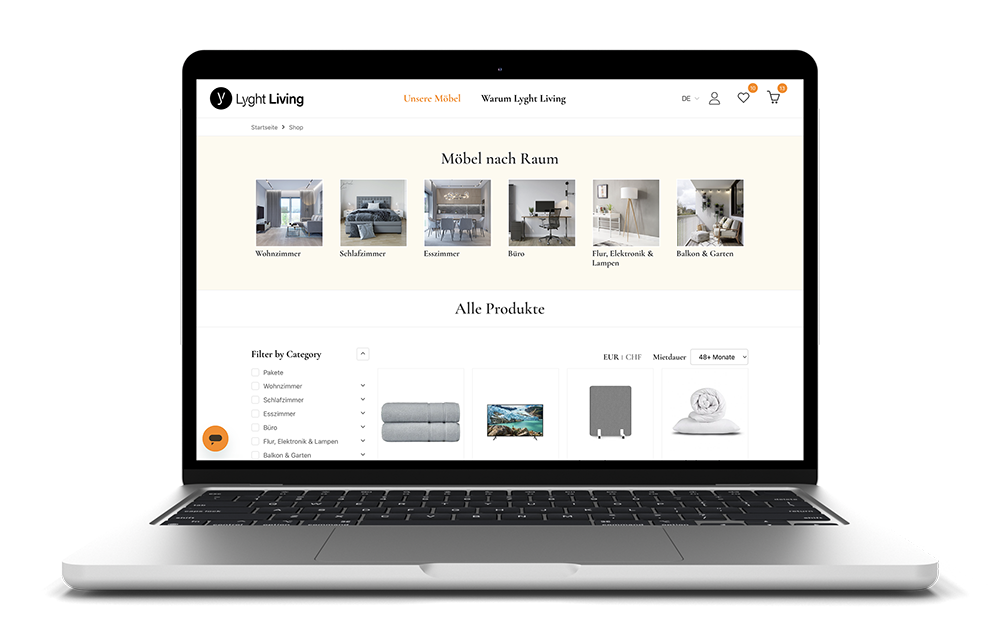
The situation: a European address, an empty apartment, a fixed end date
The contract is for fourteen months. The apartment is signed, keys already in hand, but every room is empty. Shipping your own sofa across a border takes weeks and rarely makes sense for a stay this short. Buying new furniture just means reselling, storing or disposing of it later, and none of that fits a fixed end date.
This is the situation furniture rental was built for, and it isn’t unique to fourteen-month secondments: corporate relocations, project-based stays and the gap between two permanent homes create the same empty-apartment problem. Lyght Living and other European providers deliver, assemble and later collect the furniture, so your real decision comes down to three options: rent, buy, or ship what you already own. Which one fits depends on your dates, your budget and how much certainty you actually have about how long you’re staying. The rest of this article works through that decision step by step.
What furniture rental actually is (and how it differs from rent-to-own or event hire)
Furniture rental means paying for the use of furniture for a defined period and returning it afterward. You never own it, and there’s no resale to organise when you move out. That’s a different product from US-style rent-to-own, and a different product again from party or event hire, even though all three sometimes get called “furniture rental” in casual conversation.
Rent-to-own models are structured around eventual ownership. One large US retailer markets a catalog-based offer built on flexible payment plans and free delivery [1]: you pay in instalments until the furniture becomes yours. That solves a different problem than a fourteen-month posting, where owning the furniture at the end was never the point.
Event and party rental is a separate category again. Specialists in that space supply tables, chairs and tableware for occasions, weddings, conferences, product launches [2], not everyday living or working. A sofa and a bed for a year need a different kind of provider than a two-day trade fair does. Lyght Living sits in neither of those categories. The focus is complete living, working and project environments over longer, more complex stays, with full-service delivery rather than isolated furniture drop-offs.
When furniture rental in Europe makes sense
Furniture rental tends to make sense whenever the furnished period has a shape, a start and an end, rather than being open-ended homeownership. For someone moving to a new country on assignment, that shape is usually set by an employer, a visa or a project timeline, not by personal choice.
A few situations come up again and again for private renters and expats specifically:
- A fixed-term work assignment. The end date is already known, so the furniture only needs to last as long as the posting does.
- Corporate relocation. Someone still has to furnish the apartment before the first day of work, whether it’s one employee or a small team arriving together.
- Interim housing between two permanent homes. Selling one place and buying another rarely lines up perfectly. Renting bridges the gap without buying furniture you’ll move again in six months.
- A defined project stay. A hospital rotation, a construction project, a sabbatical, anything with a set duration but an uncertain long-term address.
The same full-service model also works at the account level for relocation consultants, HR teams or serviced-apartment operators arranging housing on someone else’s behalf, though this article stays focused on the person actually moving in.
What’s included: delivery, assembly, collection and exchange
“Full-service” sounds like marketing language until you compare it to doing it yourself. In practice it means you don’t coordinate a delivery van, a separate assembly person and a disposal service for three different pieces of furniture. One provider handles all of it, from the first consultation through collection at the end.
At Lyght Living, that scope covers consultation, a furnishing concept, product selection, delivery, setup, assembly, installation, collection, exchange and project coordination as one service. Practically, that means the apartment doesn’t arrive in flat-pack boxes with a Saturday afternoon of assembly ahead of you. Some providers publish concrete delivery windows to set expectations: one US-based service commits to delivery within about a week of ordering, though coverage is checked by zip code and limited to specific areas [3]. The principle carries over here too: ask any provider what their actual delivery lead time is for your address, not for the country in general.
Exchange matters more than it sounds. A family member visits for a month and you need an extra bed, or the desk you picked turns out too small: exchange means solving that with a call instead of buying a second piece of furniture you’ll have to get rid of later.
And when the stay ends, there’s no listing to write, no buyer to arrange a pickup with, no storage unit to rent in the meantime. The furniture is collected, and that’s the end of your involvement with it.
Rental terms, extensions and early exit: how flexibility really works
At Lyght Living, standard rental terms run from a single day up to 48 months, renewing automatically until you cancel, rather than ending abruptly on a fixed date. Ending the contract earlier than planned is also possible, though it isn’t free cancellation, and it’s worth understanding the difference before you sign.
Here’s how the mechanics work in practice:
| Rental length | How renewal works | How you end it |
|---|---|---|
| 1 day to 3 months | Renews automatically, one week at a time | 5 working days’ notice to the end of the current term |
| Over 3 months, up to 48 months | Renews automatically, one month at a time | 5 working days’ notice to the end of the current term |
The point of auto-renewal is that you’re not forced to guess the exact length of your assignment on day one. The contract keeps rolling until you actively end it.
Early termination is available too, but only after six completed rental months, again with 5 working days’ notice to the end of that month. The balance is then recalculated based on how long you actually rented, not the term you originally booked. A shorter actual period can mean a higher effective monthly rate applies retroactively, and any resulting difference is payable as a lump sum. It isn’t a penalty. Discounts tied to longer commitments simply don’t carry over if the commitment turns out shorter.
If a temporary stay quietly becomes permanent, a later purchase may be possible through an individual purchase calculation based on the rental payments already made, rather than an automatic switch to ownership. Whichever provider you compare, ask three questions: what happens if you do nothing, what does ending early actually cost, and what does buying later actually involve.
What furniture rental costs — and when it’s cheaper than buying
Furniture rental is billed as a recurring monthly rate rather than an upfront purchase. The rate depends on how much you’re furnishing, for how long, and where. Lyght Living’s own European rental page lists pricing starting from a monthly rate, with delivery and setup included [6], which is a reminder that the headline number rarely tells the full story until you know the scope behind it.
A few factors reliably move the monthly rate: how many rooms you’re furnishing, whether you need a kitchen and appliances on top of living-room and bedroom furniture, the quality tier you choose, and the length of the term itself, since longer commitments typically bring the effective monthly cost down.
To put purchase prices in perspective, a snapshot of sofa listings on one large online marketplace showed prices from around $100 to over $40,000, with a median close to $300; office chairs ranged from roughly $36 to $315, median just under $100 [5]. That’s a US marketplace snapshot, not European rental pricing, but it illustrates something real: the purchase price alone spans a huge range before you’ve added delivery, assembly, and the cost of getting rid of the piece when you move out.
Whether renting or buying works out cheaper depends on your specific numbers: how long you’re staying, what you’d actually recover reselling the furniture, and what shipping or storage would cost in the meantime. Lyght Living doesn’t publish a universal breakeven point, because it depends on rental duration, location and scope. As a general pattern, longer stays give buying more time to pay off, while shorter, fixed-end stays leave less room for resale or storage costs to even out. That’s also why a later purchase calculation exists, for renters whose plans turn out longer than expected.
| Option | Upfront cost | Time to move-in ready | What happens at the end |
|---|---|---|---|
| Buy new | Full purchase price paid upfront | Delivery plus your own assembly time | You resell, store or dispose of it yourself |
| Ship your own furniture | Packing and freight costs, no new purchase | Often weeks, depending on distance and customs | Makes the return trip too, eventually |
| Full-service furniture rental | Monthly rate, delivery and setup typically included | Delivery scheduled by the provider, often within days | Collected at the end of your term, no resale to arrange |
Choosing a furniture rental provider in Europe
Not every provider that shows up in a search for “furniture rental” solves the same problem. It helps to compare on specifics rather than on how polished the website looks, and to weigh each provider against what a full-service model like Lyght Living’s actually delivers.
- Service area. Confirm exactly which cities, postcodes or countries a provider actually delivers to before getting attached to a quote. Coverage models vary widely: some rental networks market availability across many countries [4], while others work within a handful of postcodes. Lyght Living operates within its own defined service area, so check your address falls inside it before assuming a proposal will work.
- Scope. Is this one sofa, or a fully furnished apartment including kitchen and appliances? Full-service providers coordinate the whole space as one project rather than shipping isolated pieces.
- Delivery lead time. Ask for a real date tied to your address, not a general country-level promise.
- Condition of the furniture. At Lyght Living, rental pieces are refreshed to arrive like new for each customer.
- Contract clarity. Understand the renewal cycle, the notice period, and what happens if you need to end early, before you sign.
- Cross-border support. If your assignment might extend into a second country, ask whether the provider supports that move directly or whether you’d be starting over elsewhere.
For a closer look at how rental compares with buying room by room, see our rent-vs-buy guide.
Frequently asked questions about furniture rental
Is furniture rental cheaper than buying? It can be, particularly for shorter stays where resale value, storage or shipping would otherwise eat into any savings from buying. For long-term stays measured in years, buying may work out cheaper overall. The answer depends on rental duration, location and scope, not a fixed rule.
What are the downsides of renting furniture? You don’t own the pieces, so there’s no resale value to recover at the end. Ending a contract earlier than planned isn’t free: at Lyght Living, early termination after six completed months triggers a recalculation based on actual duration, which can mean a payable difference. Over a very long stay, total rental payments can exceed what buying outright would have cost.
How much does furniture rental typically cost? It depends on the number of rooms, the quality tier, the duration and the location, so there’s no single figure that applies everywhere. The most reliable way to know is to request a proposal for your specific apartment and dates rather than rely on a generic price list.
Where can I rent furniture in Europe? Through full-service providers that operate in your specific location, since most work within a defined service area rather than covering an entire continent. Coverage varies by provider: some networks are broader, others, including Lyght Living, focus on a defined European service area. Confirm coverage for your exact address before assuming a quote applies.
Are short-term furniture rentals available? Yes, though minimum terms vary by provider. Lyght Living’s standard rental periods start from a single day, while other providers set longer fixed minimums, sometimes several months. Check the minimum term before assuming a short stay is possible.
Next step: request a rental furniture proposal for your European address
If the timeline is real and the apartment is empty, the next useful step isn’t more research, it’s a proposal built around your actual address and dates. Send Lyght Living your location or postcode, a floor plan or simple room list, your move-in date, and how long you expect to stay. In return, you’ll get a furnishing proposal scoped to your rooms and dates, with delivery, assembly and later collection already built in, rather than a generic price list that leaves you to work out the rest.
Sources [1] Buddy’s Home Furnishings, rent-to-own furniture catalog, buddyrents.com [2] Party.Rent, event and occasion furniture rental, party.rent [3] The Everset, furniture rental with zip-code service areas, theeverset.com [4] The CORT Global Network, international relocation-furniture network, cortglobal.com [5] Marketplace price snapshot, amazon.com, sofa and office chair listings, illustrative only [6] Lyght Living, European furniture rental page, lyght-living.com/en/europe/