The Situation: When Renting Office Furniture Beats Buying
The lease for a new satellite office is signed. The team is meant to double within six months. Nobody can say yet if that means 12 people or 30. Buying desks and chairs now means guessing a headcount that keeps shifting, then living with whatever was bought once the plan changes. This is the moment office managers and HR teams start comparing office furniture rental companies, including providers such as Lyght Living, instead of placing an order with a furniture retailer.
Uncertain headcount is only one trigger. A project office with a fixed end date. An interim space during a renovation. A team outgrowing a floor faster than procurement can approve a purchase order. All three lead to the same question: does it make sense to own furniture for a situation that might not last? Renting turns a capital purchase into a recurring operating cost that’s easier to adjust when plans change. It also removes work nobody budgets time for: sourcing several suppliers, storing spare stock, eventually reselling or disposing of furniture nobody wants anymore.
None of this makes buying wrong. It makes renting worth comparing before signing a purchase order. Comparing providers properly takes more than a quick search.
What Office Furniture Rental Companies Actually Do
An office furniture rental company supplies workplace furniture on a fixed-term basis instead of selling it. The better ones handle the logistics around it too, not just the furniture. Typical inventory covers desks, ergonomic chairs, benching systems, conference and meeting tables, reception and lounge seating, acoustic products, filing and storage, and general accessories.
Where providers differ is service scope. Some function as a drop-off supplier: furniture arrives on a pallet, and the customer assembles and arranges it. Others operate full-service, coordinating consultation, space planning, delivery, setup and later collection or exchange as one package.[1][2] One US provider bundles free space planning from design professionals into every quote, helping fit desks, chairs and boardroom tables into a floor plan before anything is delivered. A regional East Coast provider goes further, folding project management, installation and pickup into its standard service rather than pricing them as extras.
It helps to separate this category from classic short-event or trade-fair furniture rental. A provider built for a weekend conference booth is optimised for speed and volume, not for furnishing a working office for months with ergonomic requirements, exchange options and a collection process built for longer, more complex use.
Seven Criteria for Comparing Office Furniture Rental Companies
Providers rarely present their terms in a comparable format on their own. Work from a fixed checklist before requesting quotes.
| Criterion | What to check | Why it matters |
|---|---|---|
| Product range | Desks, ergonomic chairs, meeting and conference furniture, reception, acoustic products | A narrow catalogue means sourcing the rest from a second supplier |
| Contract flexibility | Can the term be shortened, extended or scaled up as headcount changes | Determines whether the contract can follow actual growth |
| Minimum term | The shortest period the provider will commit to | Sets whether a short project office is even an option |
| Setup and collection scope | Drop-off only, or full installation and later pickup | Decides how much internal time the office spends on logistics |
| Space planning support | Included, or billed separately | Affects whether the layout works before furniture arrives |
| Geographic coverage | Regional, national or across specific countries | A multi-site plan needs a provider that can actually deliver everywhere |
| Quality and condition standards | How furniture is inspected and refurbished between rentals | Determines what actually shows up at the office |
Minimum term
This is easy to overlook until a second quote arrives. One Mid-Atlantic provider sets a three-month minimum with month-to-month extensions after that.[3] Another national provider advertises one-, three- or six-month terms aimed at businesses still testing their space needs.[4] Neither approach is wrong. But a project office booked for eight weeks needs to know upfront whether a provider’s minimum term even fits.
Setup and collection scope
Some providers position full installation, arranging furniture rather than leaving it at the door, as their difference from drop-off-only competitors.[3] For an office team with no spare hands to assemble desks after hours, that distinction changes how much internal coordination the project actually needs.
Geographic coverage
Coverage varies widely between providers, from single-region operators to those covering a whole country or several markets.[1][2][3] None of that is a flaw. The same request can get a very different answer depending on where the office sits, so coverage is worth confirming before a floor plan goes any further.
Matching a Provider to Your Workspace Scenario
The right provider depends on what the office needs to do, not just how many desks it needs.
New office fit-out. A fit-out benefits from a provider that includes space planning, since the floor plan and the furniture order should be solved together.
Interim space or project office. Contract flexibility and a short minimum term matter more here than a large catalogue. The furniture only has to work for a defined stretch.
Growing team. Look for a provider that can add desks and chairs mid-contract without renegotiating from scratch.
Single conference room or reception. Some providers explicitly quote renting conference furniture for a one-time board meeting, or reception and waiting-room furniture as a standalone request, separate from furnishing a whole floor.[2] If the actual need is one room, ask directly whether the provider will quote that scope rather than folding it into a full-office minimum.
Home-office setups for remote employees. At least one provider runs a dedicated home-office rental option, giving remote staff professional-grade furniture without the company buying and shipping it outright.[2] Ask any provider considered for this whether they support single-desk, single-address deliveries. That logistics profile is very different from furnishing one office floor.
Contract Terms That Actually Matter
The terms that decide whether a rental works in practice are the minimum term, the renewal mechanism, the notice period, and what happens on early termination. These rarely show up on a pricing page. Ask for them in writing before comparing quotes on price alone.
At Lyght Living, standard rental periods run from one day to 48 months. Contracts renew automatically: weekly for terms up to three months, monthly for longer terms, until either side gives notice. Standard notice is five working days to the end of the current term. That structure means a project office doesn’t need a brand-new contract every time it extends by a few weeks. It also means a forgotten cancellation quietly keeps billing, so calendar reminders matter.
Early termination is the clause worth reading twice. At Lyght Living, ending a contract early is possible after six completed rental months, with five working days’ notice to the end of the month. The remaining balance is then recalculated based on the actual rental duration completed. That can mean a higher effective monthly rate than originally quoted if the term ends up shorter than planned. Previously granted discounts are not automatically reapplied. This is not free cancellation, and no provider offering flexible terms should be expected to work that way. Ask any provider how they recalculate the balance if a contract ends earlier than planned.
Finally, ask whether a later purchase is possible if the office decides to keep the furniture permanently. At Lyght Living, a later purchase may be possible through an individual calculation based on rental payments already made, rather than furniture becoming the customer’s property automatically at the end of the term. Confirm exactly how that calculation works before assuming a conversion happens on its own.
What Office Furniture Rental Costs
There is no flat market rate for office furniture rental. Price depends on scope, contract length, delivery and setup requirements, and which services are bundled in versus billed separately. Two providers quoting the same 20-desk office can land at very different totals once installation, exchange rights and collection are factored in.
Even outright purchase prices vary before rental enters the picture. A recent market snapshot of office desks for sale showed prices from under 70 US dollars up to nearly 790 US dollars, with a median around 105, all within the same basic product category.[5] That spread exists for a single desk bought outright. A rental quote adds contract length, delivery, setup and collection on top. A single “price per desk” from any provider is one input, not the full picture.
Request quotes against an identical scope: same furniture list, same location, same rental duration, same inclusion or exclusion of delivery and setup. Ask each provider what’s included and what’s billed as an extra. Without that normalisation, a lower headline number can hide a shorter minimum term, a smaller service scope, or delivery charged separately.
Downsides and Limits of Renting Office Furniture
Renting isn’t right for every situation. An office with a stable, long-term footprint and no expectation of moving, downsizing or expanding for years may find buying simpler over that timeframe, since there’s no recurring contract to manage once the furniture is paid off. Highly customised built-ins, bespoke joinery, or furniture designed permanently around a brand identity also sit outside what a rental catalogue typically covers.
For everything in between, temporary offices, project spaces, growing teams, uncertain footprints, renting tends to remove more friction than it adds. The decision usually comes down to how confident the office is in its own timeline.
How Lyght Living Fits In
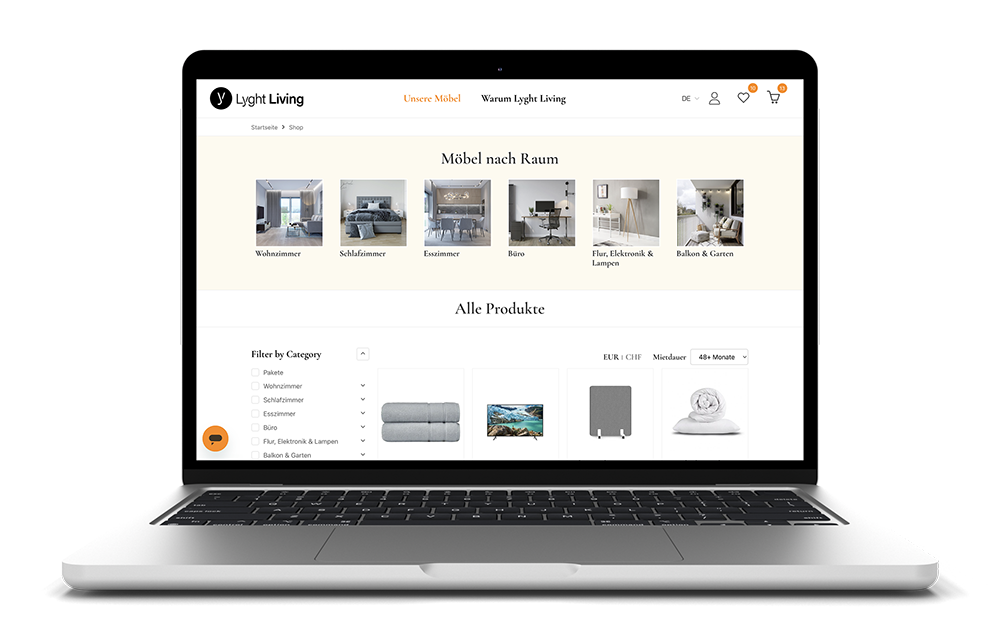
Lyght Living’s office rental furniture covers desks, ergonomic chairs, meeting and conference furniture, lounge and reception pieces, lighting, acoustic solutions such as phone booths and meeting pods, and general office accessories. Most of the checklist above is covered from one provider rather than several.
Service goes beyond delivery. Consultation, furnishing concept, product selection, setup, assembly, installation, collection and exchange are handled as one coordinated process rather than separate line items. Furniture returning from a previous rental is inspected, cleaned and refurbished where needed, so it arrives at the next office looking like new rather than visibly used.
On flexibility, Lyght Living treats furniture as an operating cost rather than a capital purchase, which is the asset-light logic behind office expansion, relocation support and scalable project offices discussed above. Contract terms follow the structure described earlier: terms from one day to 48 months, automatic renewal, and an early termination path after six completed months.
Lyght Living serves companies, real estate clients and relocation partners across the European markets it operates in. For a specific city or country, confirming coverage during a consultation is the direct route, rather than assuming it from a general description.
FAQ: Office Furniture Rental Companies
Is “office furniture rental” the same as “office furniture leasing”?
The terms are often used interchangeably in search, but a classic lease usually implies a fixed financing structure with ownership transferring at the end. Rental furniture providers, including Lyght Living, typically offer flexible terms without an automatic ownership transfer. Confirm which structure a provider actually means before assuming “leasing” and “rental” describe the same contract.
Are there office furniture rental companies near me?
Coverage varies widely by provider, from single-region operators to those serving multiple countries. A search for “office furniture rental companies near me” will surface local and national options with different footprints. Ask directly which locations a provider currently delivers to, since service areas change over time and shouldn’t be assumed from a website’s general description.
Can I rent furniture for a remote employee’s home office instead of the main office?
Some providers offer this as a distinct service, since it involves single-address delivery rather than a full-floor installation. Confirm whether single-desk, single-address deliveries are something the provider actually supports before including it in a broader office quote.
Can I rent furniture for just one conference room or a one-off board meeting?
Yes. Some providers quote this as a standalone request rather than requiring a full-office minimum. If the need is genuinely a single event or a short meeting setup, ask specifically whether the provider handles smaller engagements or is built mainly around full office contracts.
Next Step: Request a Tailored Rental Proposal
Fill in the form below with your location, a floor plan or approximate headcount, and your planned rental duration and scope, whether that’s a full office fit-out, a single conference room, or a project office with a fixed end date. In return, you’ll receive a furnishing proposal matched to that scope, including which products fit the space and how delivery, setup and collection would be structured for your timeline.
Sources: [1] AFR, rentfurniture.com/office · [2] Commercial Furniture Rentals, commercialfurniturerentals.com · [3] Corporate Rentals, corporaterentals.com · [4] CORT, cort.com/office-furniture-rental · [5] Amazon marketplace snapshot, office desk category.